
Kayaking is one of the best ways to enjoy the outdoors, get some exercise, and explore water at your own pace. But if you’re planning a trip, you might wonder: how long does it take to kayak 4 miles? The answer isn’t as simple as a single number. Several key factors can make the difference between a relaxing afternoon and a challenging workout. Whether you’re a beginner or an experienced paddler, understanding these variables helps you plan your trip better and avoid surprises.
This article explains the most important factors that influence your kayaking speed, what you can realistically expect for 4 miles, and how to make your trip smoother. We’ll look at real-life examples, practical tips, and even some data to help you get the clearest picture.
By the end, you’ll know exactly what to consider before heading out on your 4-mile kayaking adventure.
What Determines Kayaking Time Over 4 Miles?
Several things affect how fast or slow you’ll complete a 4-mile kayak trip. The four most important are:
- Your paddling speed (skill and fitness)
- Type of kayak
- Water and weather conditions
- Breaks and stops
Let’s look at each one closely.
1. Your Paddling Speed (skill And Fitness)
Your own ability is the biggest factor. If you’re new to kayaking, you’ll likely paddle slower, need more rest, and use less efficient strokes. More experienced or fit paddlers move faster and waste less energy.
- Beginners usually paddle at 2–2.5 miles per hour (mph).
- Intermediate paddlers can manage 2.5–3 mph.
- Experienced kayakers often sustain 3–4 mph or more.
Let’s compare time to kayak 4 miles based on these speeds:
| Experience Level | Average Speed (mph) | Time for 4 Miles (hours:minutes) |
|---|---|---|
| Beginner | 2.0 | 2:00 |
| Intermediate | 2.5 | 1:36 |
| Experienced | 3.5 | 1:09 |
Most people will fall somewhere between beginner and intermediate speeds, especially if they’re paddling for fun and not racing.
Non-obvious insight: Many beginners overestimate their stamina. Paddling for over an hour without rest can feel much harder on water than it sounds. It’s smart to build up your endurance before attempting a longer trip.
2. Type Of Kayak
Not all kayaks are equal. The design, weight, and length of your kayak make a big difference in your speed.
- Recreational kayaks (short, wide, stable) are common for beginners but slower. Average speed is 2–2.5 mph.
- Touring kayaks (longer, narrower) track better and go faster. Average speed is 2.5–4 mph.
- Sit-on-top kayaks are easy to use but often slower due to their shape.
- Racing kayaks are made for speed but require skill to keep upright.
Here’s how different types might affect your 4-mile time:
| Kayak Type | Typical Speed (mph) | 4-Mile Time (hours:minutes) |
|---|---|---|
| Recreational | 2.0 | 2:00 |
| Touring | 3.0 | 1:20 |
| Racing | 4.0 | 1:00 |
| Sit-on-top | 2.2 | 1:49 |
If you’re renting, most places offer recreational or sit-on-top kayaks, so plan for a slower pace unless you have your own high-performance model.
Non-obvious insight: Heavier kayaks are harder to accelerate, especially in windy conditions. Traveling light makes a bigger difference than most people expect.
3. Water And Weather Conditions
The environment can help you paddle faster or slow you down. Here are some common conditions and their impact:
- Calm, flat water: Best for speed. You’ll use less energy, and your kayak glides smoothly.
- Wind: Headwinds slow you down and tire you out. Tailwinds can help, but side winds make steering harder.
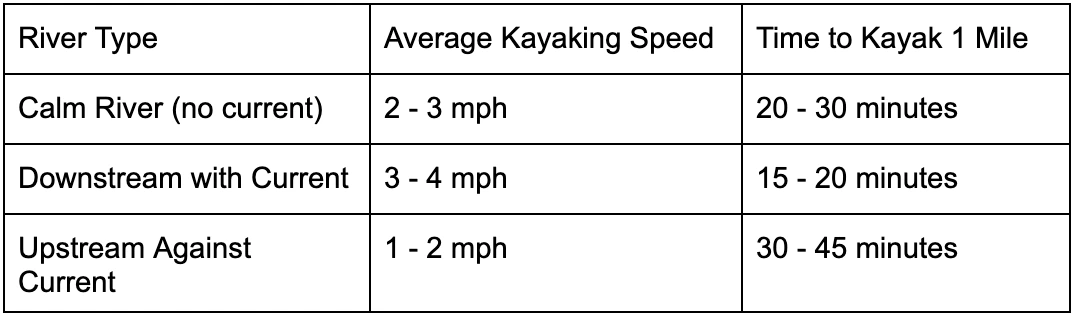
- Currents: If the current flows in your direction, you’ll go faster with less effort. Paddling against a current is much harder.
- Waves: Small waves slow you slightly, while big waves can halve your speed or even stop your trip.
Let’s see how conditions affect your time:
| Condition | Effect on Speed | 4-Mile Time Change |
|---|---|---|
| Strong headwind | -0.5 mph | +30 minutes |
| Tailwind | +0.5 mph | -20 minutes |
| With current | +0.7 mph | -25 minutes |
| Against current | -0.7 mph | +35 minutes |
| Choppy water | -0.5 to -1 mph | +30 to +60 minutes |
Always check the weather and water conditions before starting your trip. Even a light wind can add a lot of time, especially over several miles.
Non-obvious insight: On some rivers and coastal areas, tides and currents can change quickly. Knowing the timing of tides can let you ride a helpful current, saving both time and energy.
4. Breaks And Stops
No one paddles non-stop, especially over several miles. You’ll need to rest, drink water, or take photos. These breaks add time to your total trip.
A good rule:
- Plan to take a 5-minute break every 30–45 minutes.
- Beginners may need breaks every 20–30 minutes.
If you add just 10 minutes of breaks to each hour of paddling, your total trip time can increase by about 15–25%. For a 4-mile trip that might mean 15–30 minutes extra.
Practical tip: Use breaks to stretch your back and shoulders. This prevents cramps and lets you enjoy the scenery.
How Long Does It Take Most People To Kayak 4 Miles?
Putting all these factors together, here’s what an average kayaker can expect:
- Beginner, recreational kayak, calm water: 2 to 2.5 hours (including breaks)
- Intermediate, touring kayak, calm water: 1.3 to 1.7 hours (including breaks)
- With wind or current against you: Add 30–60 minutes
- With wind or current helping: Subtract 20–30 minutes
Here’s a realistic example:
Maria, a beginner, rents a sit-on-top kayak at a lake. She paddles at about 2 mph, takes two 10-minute breaks, and the water is calm. Her total trip takes 2 hours and 20 minutes.
If she paddled a touring kayak and had a light tailwind, she could finish in about 1 hour and 20 minutes.
.jpg "How Long Does It Take to Kayak 4 Miles? Expert Timing Guide")
Credit: www.umiak.com
Examples Of 4-mile Kayak Trips
To make it clearer, here are a few real-life situations:
- Lake Paddle: You take a recreational kayak on a calm lake. No wind, flat water. It takes you about 2 hours, including a break.
- River with Mild Current: You kayak downstream on a slow river. The current helps, and you finish in 1 hour and 20 minutes.
- Coastal Paddle with Headwind: You paddle along the coast, but there’s a headwind. It takes 2.5 hours because you have to work harder.
- Group Paddle: You go with friends. The slowest person sets the pace. The group finishes in 2 hours and 15 minutes with extra breaks.
Tips To Kayak 4 Miles Faster And Safer
If you want to improve your 4-mile kayak time or just have a better trip, here are some helpful tips:
- Practice good paddling technique. Use your core, not just your arms, for stronger and more efficient strokes.
- Check conditions before your trip. Weather apps, local reports, and talking to other kayakers can save you trouble.
- Travel light. Only bring what you need. Heavy gear makes paddling slower and tires you out faster.
- Hydrate and snack. Water and a quick snack keep your energy up and help you focus.
- Wear the right clothing. Dress for the water temperature, not just the air. Quick-drying layers are best.
- Paddle with a buddy. It’s safer and more fun, especially if something unexpected happens.
- Know your limits. If you feel tired, stop and rest. It’s not a race unless you want it to be.
Extra insight: Many paddlers forget about the return trip. If you paddle 4 miles out and back, plan for extra time and energy on the way back, especially if the wind or current changes.
Credit: www.blazinpaddles.com
How To Estimate Your Own 4-mile Kayak Time
You can predict your trip time by testing your speed in a safe area. Paddle for 15 minutes at a steady pace and see how far you go. Multiply that distance by 4 to get your speed per hour. Use this to estimate your 4-mile trip.
Always add extra time for breaks and unexpected delays.
For more detailed info on kayak speeds and safety, the Wikipedia Kayak page is a great resource.
Frequently Asked Questions
How Long Does It Take A Beginner To Kayak 4 Miles?
Most beginners will need 2 to 2.5 hours to kayak 4 miles, including breaks. This depends on their fitness, the kayak type, and water conditions. Going slower at first is normal and helps prevent fatigue.
What Is A Good Speed For Kayaking?
A good average speed for kayaking is 2 to 3 mph for most people. Experienced paddlers in faster kayaks may reach 3.5 to 4 mph or more, but this takes practice and good conditions.
How Far Can You Kayak In A Day?
With enough breaks and steady paddling, many people can kayak 10 to 20 miles in a day on calm water. Beginners should start with shorter trips and build up endurance before attempting long distances.
Does Wind Affect Kayaking Time A Lot?
Yes, even a moderate wind can slow you down by 0.5 mph or more. Headwinds are especially tiring, while tailwinds can help. Always check wind forecasts before planning your trip.
Should I Worry About Currents On Lakes?
Most lakes don’t have strong currents, so they are safer for beginners. On rivers or coastal areas, currents can be strong and can either help or make your trip much harder. Always check local advice before paddling in new areas.
Kayaking 4 miles is a fun and achievable goal for most people with a little planning. Knowing what to expect—and preparing for surprises—means you’ll enjoy the water and finish your trip with a smile.

Credit: www.floridastateparks.org