
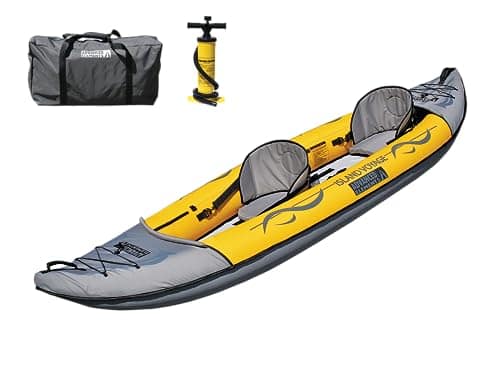


Is AdvancedFrame Good?
Yes, if your trips are mostly day outings, calm lakes, slow rivers, or short tours. The AdvancedFrame gives you the hybrid design that makes Advanced Elements kayaks interesting. Its aluminum-reinforced bow and stern help shape the hull. A tracking fin helps it stay on course. At about 10 feet 5 inches long and 36 pounds, it is much easier to move than the 13-foot Expedition.
I would pick the AdvancedFrame when my main concern is getting from the garage to the water without turning the trip into a workout. That smaller footprint also makes storage easier in a typical U.S. apartment or garage. The trade-off is clear: the 300-pound maximum load leaves less room for a large paddler plus camping gear. In the advanced elements advancedframe vs advancedframe expedition debate, the AdvancedFrame feels like the practical day-trip choice.
What Makes It Stand Out / Key Features
- Compact LengthThe kayak measures about 10 feet 5 inches, making it easier to handle on land and easier to store.
- Lightweight BuildAt about 36 pounds, it is easier to carry from a car to the launch than the heavier Expedition.
- Reinforced Bow and SternBuilt-in aluminum ribs help define the bow and stern and improve straight-line tracking.
- Tracking FinThe integrated fin helps the kayak hold its course instead of wandering with every paddle stroke.
- 300-Pound CapacityThe listed maximum load is 300 pounds, including the paddler and gear.
- Comfortable SeatThe adjustable high-back seat provides support for longer paddling sessions.
- Gear StorageBungee deck lacing, tie-down points, and hull storage give you useful space for day-trip equipment.
My Recommendation
Consider the AdvancedFrame if you mainly paddle for a few hours at a time and value easier carrying and storage. It is a good fit for solo lake trips and weekend recreation.
| Best For | Why |
|---|---|
| Day paddlers | The lighter and shorter hull is easier to transport. |
| Small garages or apartments | The compact packed size takes less storage space. |
| Casual touring | It offers useful tracking and storage without the extra bulk of the Expedition. |
Is AdvancedFrame Expedition Good?
Yes, especially if you want a solo kayak for longer trips and need more room for both your body and your gear. The Expedition stretches to 13 feet and weighs about 42 pounds. That extra length is not just for looks. It gives the kayak a longer waterline and more space for equipment. The listed maximum load is 450 pounds.
For a weekend camping trip on a U.S. lake, that extra capacity can feel like having a larger trunk in your car. You can carry more food, dry bags, clothes, and safety gear without packing every item like a puzzle. The downside is the extra 6 pounds and longer body. In the advanced elements advancedframe vs advancedframe expedition comparison, the Expedition makes more sense when touring range and gear space matter more than minimum carry weight.
What Makes It Stand Out / Key Features
- 13-Foot HullThe longer hull is built with touring in mind and gives the kayak more room for gear.
- 450-Pound CapacityThe maximum total load is 450 pounds, giving solo paddlers much more room for equipment.
- 42-Pound WeightIt weighs about 42 pounds, which is still portable but noticeably heavier than the standard AdvancedFrame.
- Nine Air ChambersThe Expedition design uses multiple chambers to support the hull and add redundancy.
- Enhanced TrackingThe longer hull, reinforced bow and stern, and tracking fin help the kayak maintain a steady course.
- Large Storage AreaThe longer design provides generous storage space for extended outings.
- Adjustable SeatThe adjustable seat with lumbar support is suited to longer hours on the water.
My Recommendation
Choose the Expedition if you plan longer solo trips, carry more equipment, or want a more touring-focused inflatable kayak. The extra size pays off when gear space matters.
| Best For | Why |
|---|---|
| Weekend touring | The 13-foot hull and high capacity leave more room for supplies. |
| Heavier paddlers | The 450-pound total capacity gives much more usable load margin. |
| Camping trips | The longer hull provides more practical storage for dry bags and camping gear. |
advanced elements advancedframe vs advancedframe expedition: Side-by-Side Test
The biggest difference in advanced elements advancedframe vs advancedframe expedition is simple: the Expedition adds length, capacity, and touring space, while the AdvancedFrame keeps the package smaller and easier to move.
Think of the AdvancedFrame as a compact SUV and the Expedition as a small touring wagon. Both can get you to the water. One simply gives you more room once you arrive.
Size and Weight: Which Is Easier?
Size matters before the kayak touches the water. A few extra pounds can feel important when you are walking from a parking lot to a launch.
| Feature | Product 1 | Product 2 |
|---|---|---|
| Length | 10 ft 5 in | 13 ft |
| Width | About 32 in | 32 in |
| Weight | 36 lb | 42 lb |
| Packed size | About 30 x 17 x 10 in | About 31 x 16 x 10 in |
⭐ Product A – 9/10 | Product B – 8/10
The AdvancedFrame has the edge for carrying and simple storage.
Capacity: Who Carries More?
If you pack a tent, sleeping bag, food, and extra clothes, capacity quickly becomes more important than a few pounds of kayak weight.
| Feature | Product 1 | Product 2 |
|---|---|---|
| Maximum load | 300 lb | 450 lb |
| Paddler count | 1 | 1 |
| Gear margin | Moderate | High |
| Camping use | Best for light loads | Better for extended loads |
⭐ Product A – 7/10 | Product B – 10/10
The Expedition has a clear edge for paddlers who carry heavy gear.
Tracking: Which Holds a Line?
A kayak that wanders can make a long paddle tiring. Both models use shaped bow and stern sections plus a tracking fin.
| Feature | Product 1 | Product 2 |
|---|---|---|
| Reinforced bow | Yes | Yes |
| Reinforced stern | Yes | Yes |
| Tracking fin | Yes | Yes |
| Touring hull length | 10 ft 5 in | 13 ft |
⭐ Product A – 8/10 | Product B – 9/10
The Expedition gets the edge because its longer hull is better suited to steady touring.
Storage: Which Fits More Gear?
This is where the advanced elements advancedframe vs advancedframe expedition choice becomes clear for campers.
| Feature | Product 1 | Product 2 |
|---|---|---|
| Deck lacing | Yes | Yes |
| Tie-down points | Yes | Yes |
| Hull storage | Available | More generous |
| Extended-trip use | Limited by capacity | Better suited |
⭐ Product A – 7/10 | Product B – 9/10
The Expedition has the edge when your dry bags start multiplying.
Comfort: Which Is Better for Long Days?
A good seat matters more after three hours than it does after thirty minutes. Both models focus on adjustable support.
| Feature | Product 1 | Product 2 |
|---|---|---|
| Adjustable seat | Yes | Yes |
| Back support | High-back support | Adjustable lumbar support |
| Foot support | Available | Adjustable foot brace |
| Long-trip focus | Good | Very good |
⭐ Product A – 8/10 | Product B – 9/10
Both are comfortable, but the Expedition is better matched to all-day touring.
Portability: Which Wins?
Inflatable kayaks solve one big problem: transport. The question is how much portability you want to keep.
| Feature | Product 1 | Product 2 |
|---|---|---|
| Weight | 36 lb | 42 lb |
| Storage | Compact | Compact but longer |
| Solo carry | Easier | More demanding |
| Car travel | Very easy | Easy |
⭐ Product A – 9/10 | Product B – 8/10
The AdvancedFrame wins for simple grab-and-go use.
Touring: Which Goes Farther?
Longer trips reward a kayak that tracks well, carries enough gear, and stays comfortable for hours.
| Feature | Product 1 | Product 2 |
|---|---|---|
| Hull length | 10 ft 5 in | 13 ft |
| Load capacity | 300 lb | 450 lb |
| Storage | Good for day trips | Better for extended trips |
| Touring role | Light touring | Stronger touring focus |
⭐ Product A – 7.5/10 | Product B – 9.5/10
The Expedition has the clear edge for longer touring and camping trips.
Final Verdict: Which Should You Buy?
The advanced elements advancedframe vs advancedframe expedition decision comes down to how you paddle. The AdvancedFrame is the easier choice for short trips, smaller storage spaces, and paddlers who want a lighter package. Its 36-pound weight and 300-pound capacity make it practical for regular recreational use.
The Expedition is the better match for long days, camping trips, heavier paddlers, and anyone who needs more gear space. Its 13-foot hull, 42-pound weight, and 450-pound capacity give it a stronger touring role. If I were packing for a weekend on a U.S. lake, I would favor the Expedition. For quick Saturday paddles, I would favor the AdvancedFrame.