
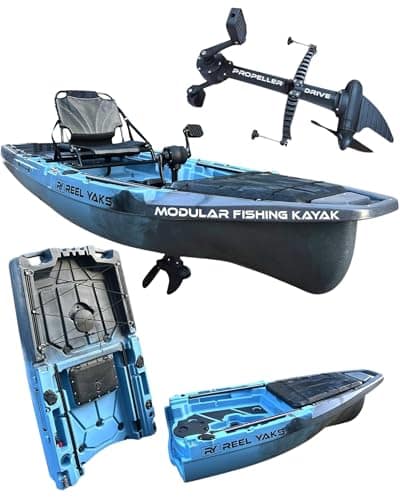
**The Reel Yaks Radar is my top overall pick for anglers who want capacity, portability, and practical fishing space.**
I know the routine. You want to fish before work or squeeze in a weekend trip, but your full-size kayak takes too much room. Then comes the drive to the lake, the lift from the truck, and the awkward walk to the water. A modular fishing kayak can make that job much easier. These kayaks break into smaller sections, so I can carry, store, and move them with less hassle. For many U.S. anglers, that means more time on the water and less time fighting gear. In this guide, I compare five models for lakes, slow rivers, ponds, and calm coastal trips.
🏆 Top 3 Products

Reel Yaks Radar Modular Fishing Kayak
Its 430-pound capacity gives anglers useful room for a person, tackle, and fishing gear.

Reel Yaks Recon Modular Fishing Kayak
The 10.5-foot size and 400-pound capacity create a useful balance for everyday fishing trips.

Reel Yaks Raptor Modular Fishing Kayak
Its compact 9.5-foot format can suit anglers who value easier handling and a smaller storage footprint.
Albott Modular Kayak With Fin Drive

The Albott Modular Fishing Kayak with Fin Drive System is made for anglers who want pedal-style control in a modular hull. Its HDPE construction is a useful fit for regular fishing use because the material is known for handling normal bumps and scrapes well. The fin drive also gives me a way to move while keeping my hands free for a rod. That can make casting and boat control feel more natural than using a paddle alone.
I see this model as a strong choice for anglers who want a compact setup without giving up the basic benefits of a pedal fishing kayak. The modular design can help with transport and storage, which matters when a garage or vehicle has limited room. I would still check the current listing for the exact packed size, weight, capacity, and included parts before buying. For calm lakes and slow water, this style can be a practical option when portability ranks high on my list.
✅ Pros
- ✔ Fin drive gives hands-free propulsion while fishing.
- ✔ Modular design can make transport easier.
- ✔ HDPE hull material suits regular recreational use.
- ✔ Pedal control can help keep both hands available for a rod.
- ✔ Compact modular sections can simplify storage.
- ✔ Fishing-focused design fits anglers who want more than a basic paddle kayak.
⚠️ Cons
- ✖ The fin drive adds mechanical parts that need care.
- ✖ Exact weight and packed dimensions should be checked before purchase.
- ✖ A modular kayak may take a little more setup time than a one-piece hull.
My Recommendation
I would consider this Albott model for anglers who want the hands-free feel of a fin drive but also need a kayak that can break down for easier storage. It makes sense for a garage, apartment, SUV, or pickup setup where a long one-piece kayak can be hard to manage. I would use it mainly on calm lakes, ponds, and slow rivers. If your main goal is simple transport plus pedal control, this model deserves a close look when comparing the best modular fishing kayak options.
| Best For | Why |
|---|---|
| Hands-free anglers | The fin drive lets you move without relying on a paddle for every stroke. |
| Small-space owners | The modular design can make storage and transport easier. |
| Lake anglers | Its fishing-focused layout fits calm-water trips. |
Albott Modular Kayak With Propeller Drive

The Albott Modular Fishing Kayak with Propeller Drive takes a different approach to pedal power. A propeller drive can offer a direct way to move through the water while leaving my hands free to handle a fishing rod. The HDPE hull adds a practical touch for anglers who expect normal contact with docks, banks, and other hard surfaces. The modular body also targets the same big problem that many kayak owners face: moving and storing a long hull.
I like the idea of this model for anglers who want pedal propulsion but prefer a propeller system over a fin system. The choice between the two can come down to water conditions, weed exposure, personal feel, and ease of use. Before buying, I would confirm the current drive details and included accessories because product packages can change. For anglers who want a modular fishing kayak with a pedal drive, this Albott model gives me another useful option to compare.
✅ Pros
- ✔ Propeller drive provides hands-free movement.
- ✔ Modular construction can reduce transport problems.
- ✔ HDPE construction is suited to normal outdoor use.
- ✔ Fishing use can be easier when both hands stay free.
- ✔ Propeller drive gives anglers an alternative to fin systems.
- ✔ A modular format can help owners with limited storage space.
⚠️ Cons
- ✖ A propeller drive needs care around shallow water and underwater obstacles.
- ✖ Drive parts can add maintenance needs compared with a basic paddle.
- ✖ Buyers should confirm current dimensions, capacity, and included accessories.
My Recommendation
I would point this model toward anglers who want a modular hull and prefer a propeller drive. It can be a good match when hands-free movement matters during casting, lure work, or slow cruising. I would pay close attention to water depth and underwater plants because a propeller needs room to work. If you want a pedal kayak but do not want a fin system, this model is worth placing on your comparison list.
| Best For | Why |
|---|---|
| Propeller-drive fans | The drive system gives anglers a pedal-based alternative to fin propulsion. |
| Casual lake trips | The modular format works well for anglers who fish calm water. |
| Storage-conscious owners | The modular build can be easier to store than a long one-piece kayak. |
Reel Yaks Raptor 9.5-ft Modular Kayak
The Reel Yaks Raptor stands out with its 9.5-foot length and listed 380-pound capacity. That shorter size can appeal to anglers who want a modular kayak that does not feel as large as a long fishing platform. It also uses a fin drive, so I can keep my hands free while moving from one fishing spot to another. For small lakes, ponds, and calm rivers, the compact format can be easy to appreciate.
I see the Raptor as a useful choice for people who put portability near the top of their list. A shorter kayak can be easier to position in a vehicle and easier to manage on land, although the actual weight still matters. The 380-pound capacity gives useful room for the angler and gear, but I would always leave a safety margin rather than loading right up to the limit. If I wanted a smaller modular fishing kayak with pedal control, this would be one of my first models to inspect.
✅ Pros
- ✔ Compact 9.5-foot length can be easier to manage.
- ✔ Fin drive provides hands-free propulsion.
- ✔ Listed 380-pound capacity leaves room for fishing gear.
- ✔ Modular construction can simplify storage.
- ✔ Shorter hull can suit smaller launch areas.
- ✔ Fishing-focused design can work well for day trips.
⚠️ Cons
- ✖ The 380-pound capacity may give less loading room than larger models.
- ✖ A shorter hull may carry less gear than a longer fishing kayak.
- ✖ Fin drives need care around weeds, rocks, and very shallow water.
My Recommendation
The Raptor makes the most sense to me when compact size matters. I would look at it for anglers who fish alone, carry a moderate amount of tackle, and need an easier kayak to move from home to launch point. Its 9.5-foot length may also suit small waterways where a huge fishing kayak feels unnecessary. For anyone searching for the best modular fishing kayak for portability, the Raptor is a practical model to consider.
| Best For | Why |
|---|---|
| Solo anglers | The compact size fits simple one-person fishing trips. |
| Small waterways | A shorter hull can feel easier to handle in tight areas. |
| Easy transport | Its modular design and shorter length can reduce storage stress. |
Reel Yaks Recon 10.5-ft Modular Kayak
The Reel Yaks Recon uses a 10.5-foot format and lists a 400-pound capacity. That gives it a middle-ground feel between a compact kayak and a much larger fishing platform. I like this size for anglers who need enough room for tackle and personal gear but still want a modular hull. It can be a strong fit for a full day on a lake when I want more room than a very short kayak provides.
The Recon is also interesting for anglers who want a balance between size and storage. At 10.5 feet, it offers more hull length than the Raptor while staying within a manageable range for many solo fishing trips. The 400-pound capacity gives useful loading room, though I would count my body weight, clothing, tackle, cooler, safety gear, and other items before heading out. For my search for the best modular fishing kayak, this balance makes the Recon easy to keep on the shortlist.
✅ Pros
- ✔ 10.5-foot length offers a useful middle-ground size.
- ✔ Listed 400-pound capacity provides solid room for an angler and gear.
- ✔ Modular design can make storage more flexible.
- ✔ Longer hull can offer more space than a compact model.
- ✔ The format suits longer day trips on calm water.
- ✔ It balances portability with useful fishing capacity.
⚠️ Cons
- ✖ It is larger than a 9.5-foot modular kayak.
- ✖ A larger hull may take more effort to move on land.
- ✖ Buyers should verify the current package and exact weight before ordering.
My Recommendation
I would choose the Recon when I want a little more space without moving into a very large kayak. The 10.5-foot size feels well suited to anglers who carry several tackle boxes, safety items, food, and extra fishing gear. Its listed 400-pound capacity also gives more flexibility than the Raptor’s 380-pound rating. For many recreational anglers, this mix of size and capacity makes the Recon a well-rounded option among the best modular fishing kayak choices.
| Best For | Why |
|---|---|
| Full-day anglers | The 10.5-foot format offers more room for gear and longer trips. |
| Gear-heavy trips | The listed 400-pound capacity provides useful loading room. |
| Balanced setups | It sits between compact and larger fishing kayak sizes. |
Reel Yaks Radar 10-ft Modular Fishing Kayak
The Reel Yaks Radar is a 10-foot modular fishing kayak with a listed 430-pound capacity. That capacity gives it a clear advantage for anglers who carry more than a rod and a small tackle box. I like the 10-foot length because it stays compact enough for many storage setups while giving useful space for fishing gear. It is the model I would study first when capacity is one of my main buying factors.
The Radar also fits the main reason many people look for modular kayaks in the first place. I can break down the kayak for storage and transport instead of dealing with the full length every time. A 430-pound rating does not mean I should load the boat to its maximum, so I would keep a safe margin for real-world use. Still, the combination of a 10-foot hull and higher listed capacity makes the Radar a strong all-around choice in this group.
✅ Pros
- ✔ Listed 430-pound capacity offers generous room for an angler and gear.
- ✔ 10-foot length provides a useful balance of size and portability.
- ✔ Modular construction can simplify storage and transport.
- ✔ The higher capacity can help anglers who carry more fishing equipment.
- ✔ A medium hull length can suit many calm-water fishing trips.
- ✔ It is a strong fit for anglers comparing capacity across modular kayaks.
⚠️ Cons
- ✖ A higher capacity does not remove the need for careful load planning.
- ✖ The actual assembled weight should be checked before purchase.
- ✖ More gear can make any kayak harder to launch and move on land.
My Recommendation
The Radar is my leading choice in this group for anglers who want a useful blend of size, storage, and load capacity. The listed 430-pound rating gives me more room to plan a real fishing load, while the 10-foot length avoids the bulk of some longer fishing kayaks. I would choose it for lake trips, calm rivers, and other suitable waters where its size fits the launch area. If I were building a shortlist around the best modular fishing kayak, the Radar would sit near the top.
| Best For | Why |
|---|---|
| Gear-heavy anglers | The listed 430-pound capacity gives more room for fishing equipment. |
| All-around lake use | The 10-foot size balances useful space with manageable length. |
| Storage-conscious anglers | The modular body can make transport and storage easier. |
Final Verdict: Which Should You Buy?
After comparing these five models, I would put the Reel Yaks Radar at the top of my overall list because its 10-foot size and listed 430-pound capacity create a useful mix for many anglers. The Reel Yaks Recon is a strong alternative when I want a 10.5-foot hull and a 400-pound rating. The Raptor stands out when I want a shorter 9.5-foot format. The two Albott models add useful choices for anglers who prefer either fin or propeller drive systems. Your water, storage space, body weight, gear load, and preferred drive should guide the final choice.
The best modular fishing kayak should make fishing easier, not add work to every trip. Focus on safe capacity, easy transport, drive type, storage, and the waters you plan to fish. A good modular kayak can turn a cramped garage or small vehicle into a practical fishing setup. Compare the details, pack smart, and choose the model that fits your real routine.
FAQs Of best modular fishing kayak
Q What is a modular fishing kayak?
Q What should I look for in the best modular fishing kayak?
Q Is a fin drive or propeller drive better for fishing?
Q Are modular fishing kayaks stable enough for fishing?
Q Can I use a modular fishing kayak on rivers and coastal water?